
All Sod orders should be placed at least two days before your pickup day. Larger orders and deliveries a week before the day you want it.
The following are Turfgrass Producers International (TPI) basic steps to a beautiful lawn. You may also download a PDF version here.
Installation of Sod
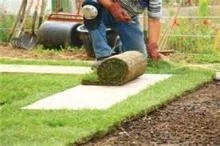
Step 1: Measuring and Ordering
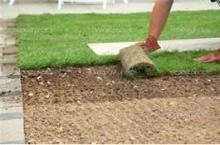

With a tape measure, get the area of your planned lawn, (or use our outline calculator). Include these measurements on a sketch of the lawn area, with the length, width, and any unusual features. Putting down sod the same day as your scheduled pickup/delivery is crucial to a strong beginning for your lawn.
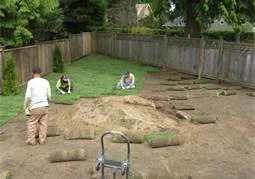
Step 2: Soil Preparation
For best result, rototill or spade the area to a depth of 10-15cm (4-6in). Eliminate drainage problems by having soil slope away from foundations, etc.
If possible, have a soil test of your prepared area by sending a sample of soil to your State Extension Service. (See listing of State Extension Services at the end of this section). Then rake in fertilizer, lime, peat, compost, etc. as needed to a depth of 7-10cm (3-4in). Rake and smooth the soil removing rocks, roots, and large clods. Roll the area lightly with a lawn roller 1/3 full of water. This will firm the soil surface and reveal low areas that need more soil. Keep the grade 2-3cm (1in) below sidewalks or driveway.
Install your lawn immediately upon pickup/delivery. Begin watering lawn within 20 minutes of installation. Turf is a living plant that requires ground contact and moisture to survive!
In hot weather, protect unlaid turf by placing stacks in shade, covering with moist burlap sacking, and/or sprinkling.
Begin installing turf along the longest straight line, such as a driveway or sidewalk. Butt and push edges and ends against each other tightly, without stretching. Avoid gaps or overlaps. Stagger the joints in each row in a brick-like fashion, using a large sharp knife to trim corners, etc. Avoid leaving small strips at outer edges as they will not retain moisture.
To avoid causing indentations or air pockets, avoid repeated walking or kneeling on the turf while it is being installed or just after watering. After installing the turf, roll the entire area to improve turf/soil contact and remove air pockets.
Step 3: Turf Installation
Give your new lawn plenty of water immediately after installation. Water daily, applying at least 1 inch of water to each irrigation zone. the sod and the soil beneath it consistently moist until the turf has firmly rooted.
Not sure how much water your lawn is receiving? Place a tuna can or similar container in the watering area and measure the amount collected while your irrigation system is running.
After approximately 2 weeks, you can begin transitioning to a less frequent, deeper watering schedule. Keep in mind that weather conditions, temperature, and soil drainage will affect how often and how much you need to water.
During hot, dry, or windy weather, make sure your new lawn receives enough moisture to stay healthy. Areas near buildings may require additional watering because reflected heat can cause the turf to dry out more quickly.
Step 4: Watering
During the first three weeks, avoid heavy or concentrated use of your new lawn. This gives the roots an opportunity to firmly knit with soil and ensures that the turf will remain smooth.
Caution
Your new sod lawn increases your property value significantly. With proper care, it will remain a great asset, providing beauty, a clean playing surface, and an improved environment.
Mow often. Generally removing no more than 1/3rd of the grass height at a mowing. Keep your mower blade sharp. You may need to mow twice a week at first. Keep mower cutting height set at no less than 2.5”. A 3” cutting height in the summer months may be best, as the taller heights shades the soil reducing moisture loss.
Weed and chemical applications are generally not needed on a new sod installation. Another one of the benefits of turfgrass sod is weeds and disease are not an issue.